
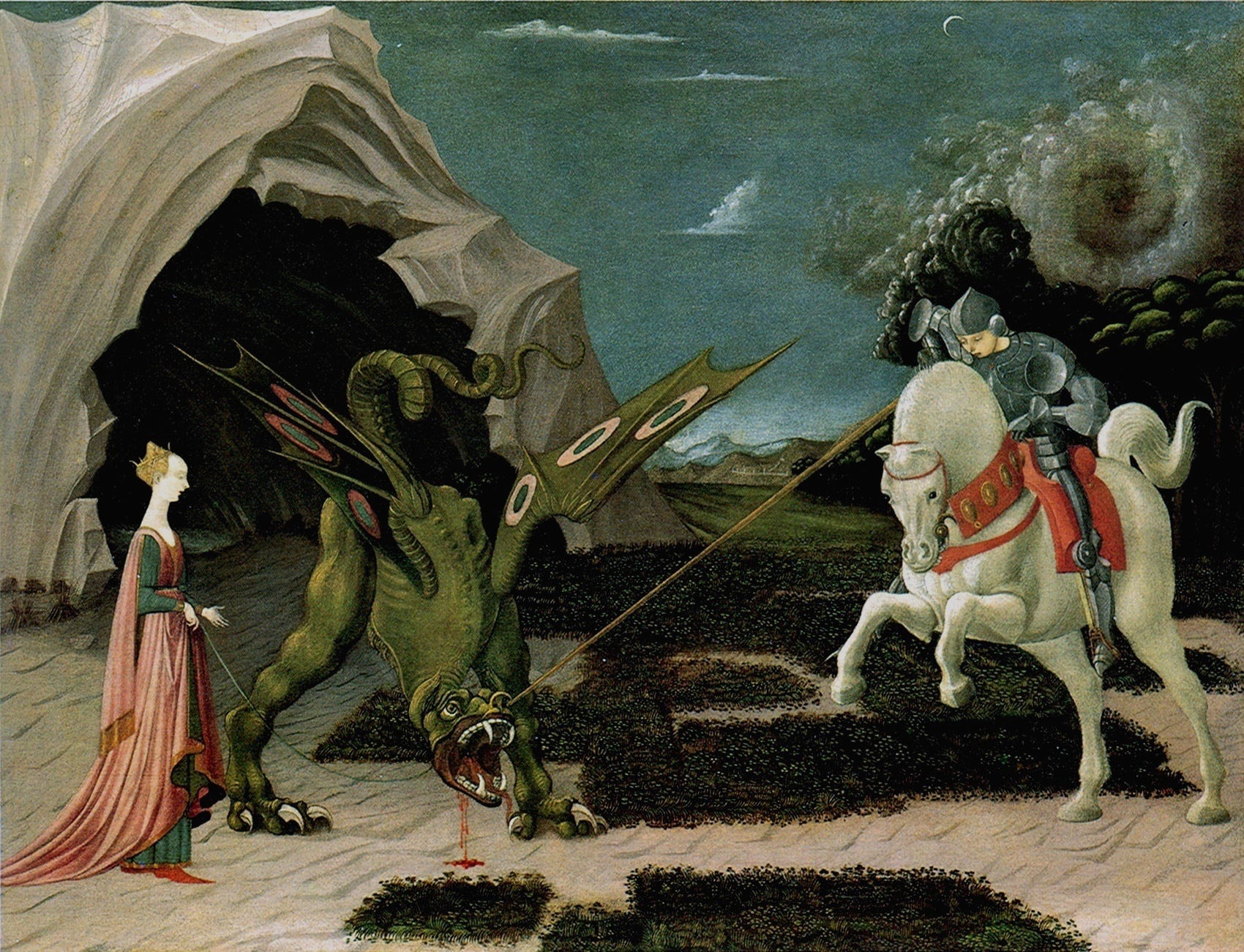
There is a man in my house, and he is always killing the same dragon. He hangs by the front door, killing it. He kills it again on the bookshelf, and in the hallway, and on a postcard tacked above my desk. Sometimes he nobly kills it in the bathroom.
I have been buying pictures of this man slaying this dragon since I was nine years old, roaming garage sales with ten dollars in my fist and a quest. I would see him with his lance raised, and a dragon underfoot. Within seconds, he would be mine.
His name is Saint George.
Over the years it became a game: spot him across a museum gift shop, a flea market, a used bookstore. I could recognize him from the tilt of his head alone. The pattern rarely varied, the artists made sure. On horseback, the dragon shrieking beneath him — and behind him, a small woman folded in on herself in fear. I found him, I bought him, and he undid me every time.
For years I could not have told you why. The answer, when it finally came, was cowering in the corner of the frame, in the figure I had spent two decades not really looking at.
And once I saw it in the painting, I saw it everywhere else. In how we canonize our heroes. In what nations do to remember themselves. In who gets to be the saint and who becomes the sacrificial thing that had to die.
What did the dragon do?
The inscription beneath the frame reads Saint George and the Dragon — but to a child it is only a title to memorize on the way to the gift shop, so you can tell your mother which painting you want.
I remember being terrified I would forget.
George. Dragon. George. Dragon.
That’s all my young mind held onto. By the time I reached the clerk’s desk, my grubby hand thrust into my mother’s softer one, I said: “George and Dragon.”
No mention of slaying or memory of saints.
I was a child. I knew nothing about Christian allegory, hagiography, or what a dragon was supposed to mean. I saw a magnificent knight on a beautiful horse, his lance angled downward at a pitiful dark shape coiled beneath him. And I remember it clearly because it confused me for years: I was holding two thoughts at the same time.
What a wonderful knight.
What a sad, sad dragon.
Children are not born knowing that dragons are evil. I did not know “slaying the dragon” had hardened into a phrase during the Christian martyrdoms of the fourth century. I only knew it as how adults explained the way a person overcomes a hard thing. No one had told me yet that it implied destruction as the necessary cost of virtue — that the killing was noble. The point of the scene was the triumph of good over evil.
To a child, the dragon was just an animal cornered at the bottom of the frame, about to be run through. And every artist — Raphael, Uccello, Martorell — had decided death is the correct verdict every time.
And somewhere underneath all that inherited certainty, the child stood in front of the picture, quietly grieving the dragon while still wanting, desperately, to become the knight. She did not yet know her own shape. The adult reached for roles without hesitation.
In The Hero with a Thousand Faces, Joseph Campbell describes how ritual dissolves the person into the role — how ceremony discloses a man to himself “not as this personality or that, but as the warrior, the bride, the widow, the priest.” The roles, it turns out, are social agreements. Archetypes. A quiet treatise on the shape of the myth we are all conscripted to uphold.
Saint George Slaying the Dragon presents one such myth.
This one painting holds at least four points of view, and they do not agree. To the woman, George is rescue, or a shield. To the horse, he is a weight, a will, a master. To the dragon, he is no saint at all — he is a horseman of the apocalypse: Conquest on a white horse, always pure, pristine, and bloodless. And that is the horror of it, from the corner of the frame: the thing arriving to end you is deemed righteous.
Campbell saw the scaffolding behind this. The universal archetype of the redeemer is the response to society’s need for a savior in the face of terror:
“The frightened world raises a cry for the redeeming hero, the carrier of the shining blade, whose blow, whose touch, whose existence, will liberate the land.”
The saint is summoned because he is needed, and that demand makes everyone clamor that he is good, long before the spear pierces through.
Don't think too hard. Look at George. He looks like every knight you have ever loved — Arthur Pendragon, Luke Skywalker, the beautiful men of Final Fantasy, translated across the centuries from gold leaf into handsome digital polygons.
But George was a man before he became a symbol.
Seven centuries after the spear
Saint George is among the most famous martyrs to emerge from the Diocletian persecution (begun 303), and remarkably little can be established about him outside the dragon.
Records hold that he was a Roman soldier of Greek descent, born around 280. In early 303, Diocletian issued an edict ordering all soldiers to sacrifice to the pagan gods, and George refused, confessing himself a Christian. Diocletian, said to have been fond of him, tried to buy him off with wealth and position — but George would not recant. He was tortured and beheaded on April 23, 303. His remains went to his hometown Lydda, now Lod, where a church was later built in his name. Within two centuries, he was venerated across the empire.
I think about George’s courage more than I expected to, because it revealed his interiority. It made room for the possibility that George was more than a memorialized messiah. That beneath the gold leaf was a man who refused an emperor kindly. A man filled with the possibility of “perhaps.” Perhaps George was a knight who was sorry the dragon was the dragon. Perhaps he would have knelt to ask the maiden her name. The record cannot give me that man. But the hope of him is the oldest thing in my collection.
Almost nothing of the man survives in the record. What endures is the dragon — and the dragon arrives late.
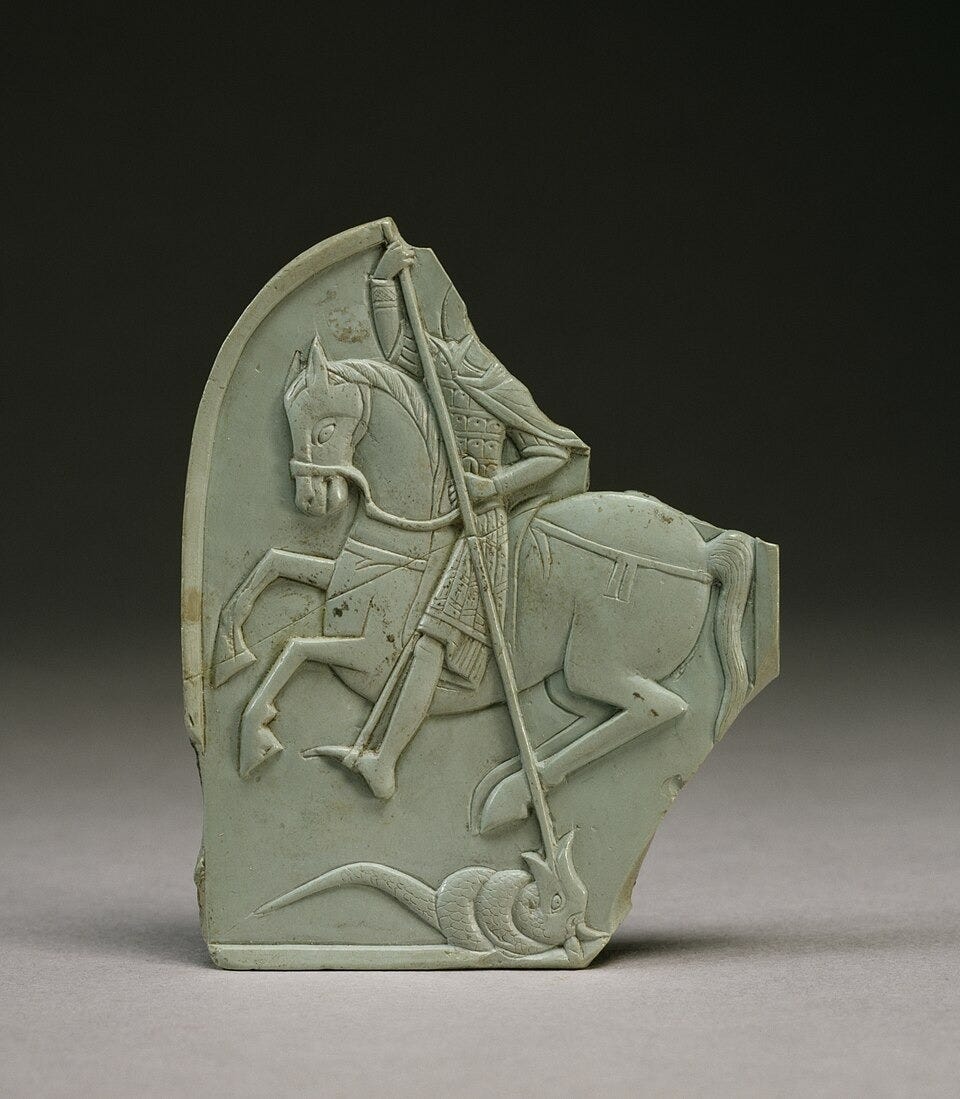

The scene is built to resolve
The dragon does not appear in the story for roughly seven hundred years. It emerges in eleventh-century writing carried west by the Crusaders, who returned with a saint they could rally behind in battle. Saint George’s story was popularized through the Golden Legend (c. 1260), a medieval compilation of martyrs and lore. In that version, a dragon terrorizes a village and can be appeased only by a daily sheep; when the sheep run out, lots are cast for a human tribute, and the lot falls to the king’s own daughter. His money and his power cannot save her, so she goes down to the dragon’s lakeside lair to wait.
George rides in on a pristine mount, draws his sword and wounds the beast. Then, and this is the part that the paintings leave out: he does not kill it.
He has the maiden leash the wounded dragon with her belt, and walk it into town like a bleeding dog.
To the terrified crowd, George says:
“Doubt not. Believe in God and Jesus Christ, and be baptized, and I shall slay the dragon.”
So the king and all his people are baptized: fifteen thousand men, not counting women and children. Satisfied, George makes the sign of the cross, slays the dragon, and saves the maiden. The slaying is not the rescue. It is the reward for a mass conversion already paid in full.
George’s sainthood is a verdict delivered by people who were never in the frame. The title comes from outside, from the society of spectators who arrived long after the spear was driven deep into dragonflesh — seven centuries after, in the dragon’s case. And yet the painting betrays none of this delay. The scene is built to deny exactly this.
Saint George is supposed to resolve. Every symbol has its assigned place and earns its weight through repetition — the same composition from Renaissance altarpieces to the studies of meticulous art students. The ritual permits only one angle. Almost never is the dragon the hero; never the maiden, or the horse.
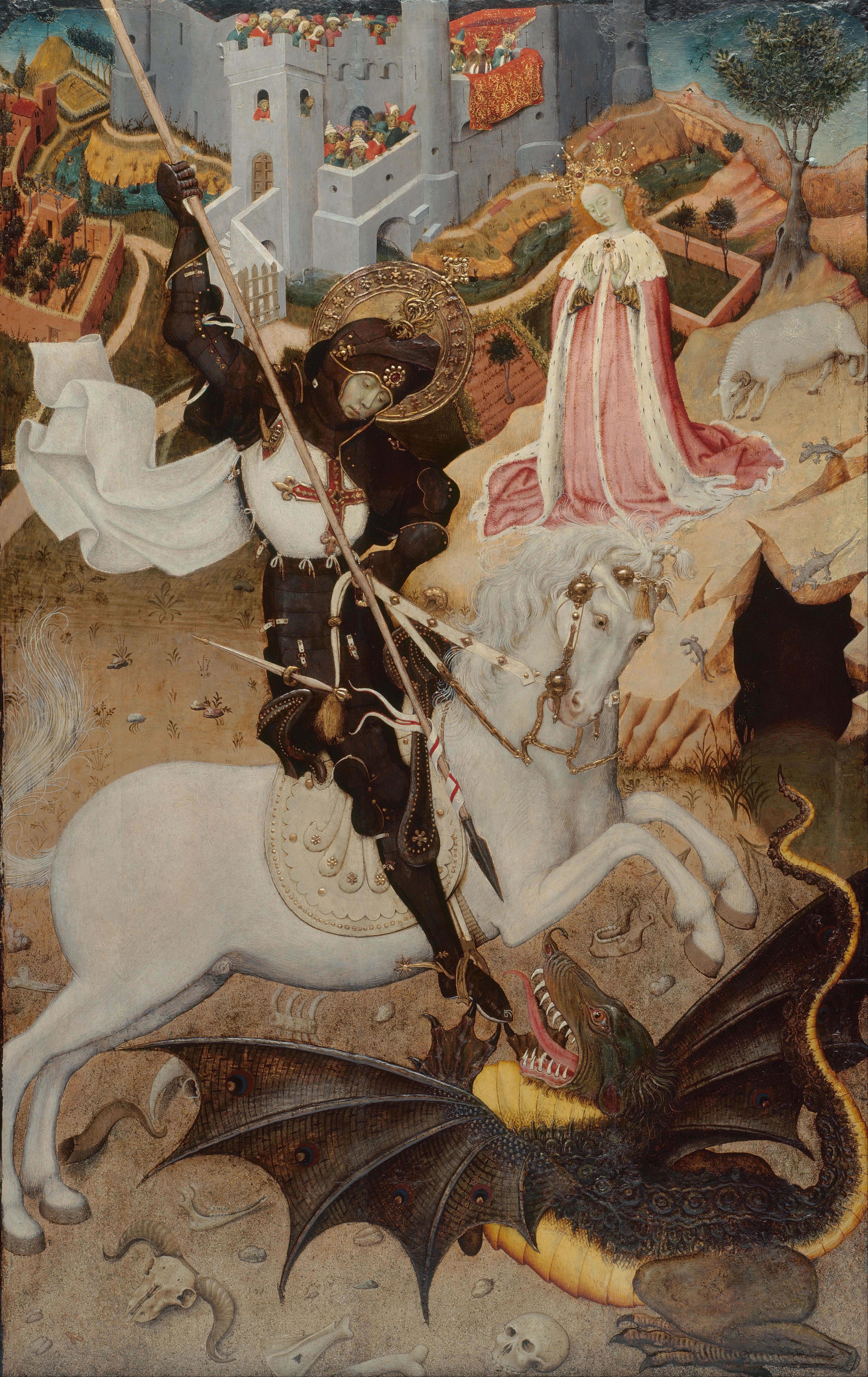
George’s veneration also mirrors the turn of an empire. The same Roman state that executed him under Diocletian would, within a lifetime, reverse itself: Constantine legalized Christianity, and by 380 it was the empire’s official religion. The persecuted faith became the imperial one — and its martyr became the empire’s rallying saint. Saint George’s story is not only good versus evil. It is the transfer of power between empires, framed as a moral rescue.
A saint, assembled
This is where I turn outward, because in the end it is not a private discomfort about a print by my door. It is the mechanism by which communities, institutions, and entire civilizations decide who their saints will be. The new myths of today are still a social agreement, even in a postmodern world that prides itself on knowing this.
A people does not simply have a shared story. It maintains one, against the constant pressure of every other account that could be told. The Romans knew this well enough to make it an office: censors, magistrates whose careful hearing of accounts gave us the word audit. Rome kept its founding myth burnished, re-carved, and retold because a founding story left untended does not survive contact with a frightened dragon's point of view.
And Rome was also somebody else’s dragon; all empires are.
…
The genius and the danger of a resilient narrative is that telling the story of what things mean and who we are remains horribly subjective. We teach children the shape of archetypes; their social environments decide whether these agreements harden into doctrine. The legend survives by swallowing the thing it describes — inquiry has nowhere to live in its maw. Eventually, the question what did the dragon do? becomes literally unaskable.
But the modern myth has been learning to turn the frame. Briseis shares her own voice in Pat Barker’s The Silence of the Girls, Circe gives hers through Madeline Miller. These are the books that take Saint George Slaying the Dragon and break it open into a diptych, a triptych, and, one hopes, a shattering: a chorus of irreconcilable views.
Saint George Slaying the Dragon. The Dragon Disappointed in George. The Woman Who Wants to Get Out of Here.
Every account becomes more arresting because it has not been so readily embalmed. Myths can only be verdicts when defended, until our children ask us why the animal had to die. And then we have to tell the story again, perhaps differently this time.
If this sounds like relativism, it isn't — or not quite. The dragon's account does not erase George's. It convicts the frame that allowed only one. A living myth is one a community keeps auditing, in the old Roman sense: heard again, weighed again. The danger was never too many voices. It is holding a single interpretation so tightly that its architecture grows teeth.
To all corners of the frame, and beyond
What is a living myth, if not a discourse that refuses to close? Oscar Wilde said that to define a thing is to limit it. So perhaps myths were never meant to be museums, where the saints are settled and the verdicts kept clean. Joseph Campbell understood this in the way he organized mythology without forgetting its metaphysical components, which he insisted were keys. Campbell described myth as a way of beholding many truths at once, a lens through which we come to understand ourselves and, in the same motion, the other.
Myths are invitations to step into the frame and inhabit each interior in turn. The stories our institutions and communities tell about themselves are the ones most likely, in the end, to come true.
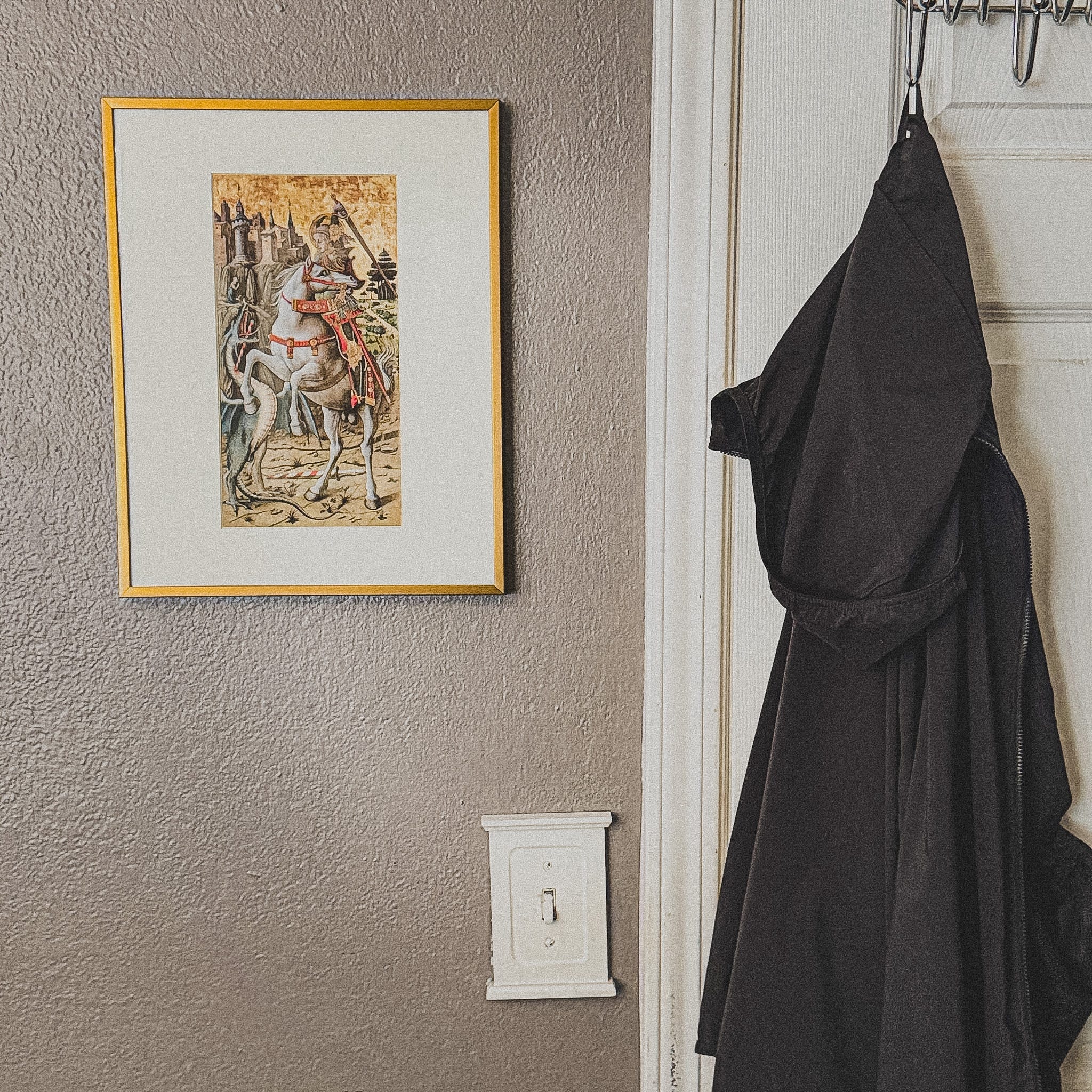
I still can’t walk past the painting without stopping. But I have made a kind of peace with the discomfort, because I finally know what it is.
It is the child in me, refusing to be educated out of seeking to understand.
I used to think the work of individuation was to learn which character you are beneath all the roles you’ve agreed to play. To find the archetypes that resonate, and keep them close, like talismans. I think now the work is the opposite. It is to stay in the doorway long enough to consider the mystery of all four — the saint, the woman, the horse, and even the dragon. And to let the dragon speak first, before I decide what it did.
What did the dragon do?
I close the door behind me, and start up the hill to find out. If all goes well, someone else will inquire even further. The myth won’t end here, and my answer will hardly be the last.
On the trail, a father holds his daughter’s hand. She is clutching a small, orange, snot-worn dragon — a Pokémon, a Charizard, the hero of her whole world.
I smile, and keep walking.
This essay emerged from my four-part Joseph Campbell salon series, where our cohort explored the relevance of Campbell’s ideas in a postmodern world.